Moral responsibility and obligation
Why do humans strive to uphold moral principles?
We identify two contexts that generate a sense of responsibility and obligation to uphold moral norms:
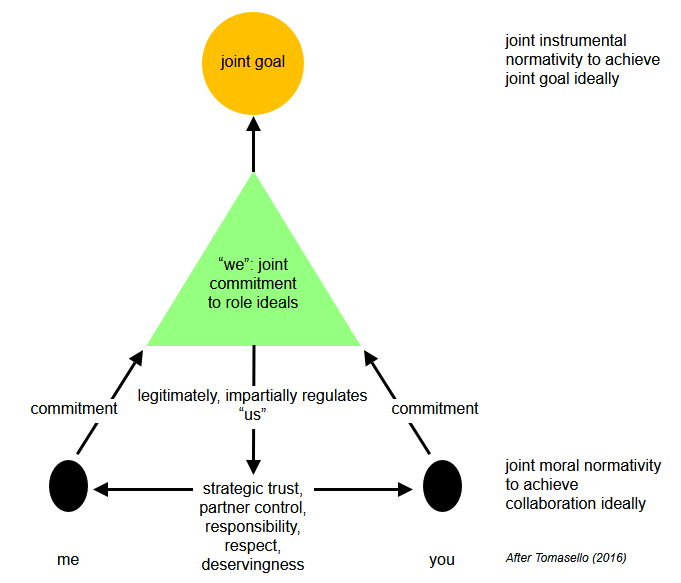
- collaborative: endorsement of and commitment to role ideals and moral principles, via voluntary commitment to collaborative partners (“what we owe to each other”) (Tomasello, 2020);
- deontological: endorsement of and voluntary commitment to moral principles directly
(“doing what is right”) (Bar-
On, 2020).
We may call these, collaborative responsibility and deontological responsibility respectively.
These contexts are linked, because cooperation is the birth-
As a human being, among other motivations, I feel a voluntary responsibility to do good; I am obliged to do good by some kind of binding force; and I will help others because I care about them.
Collaborative responsibility
You're responsible to be a good citizen.
Judge Judy
What does the word “responsibility” mean? It seems to have a number of forms which share a collaborative context. Together, the claim is that these definitions constitute “what we owe to others” (Scanlon, 1998), and equivalently, what it means to be an ideal collaborative partner.
- accountability (Darwall, 2006): to be held responsible is to be held accountable
-
to be made to give an account of oneself, to allow fault to be apportioned, to be made liable for blame and “reactive attitudes” such as resentment, anger, and indignation; and required to give a genuine apology if necessary. - moral obligation (Tomasello, 2020) is a responsibility to one's collaborative partners to be an ideal partner oneself, to treat them with respect and deservingness, that is effectively an obligation, since, for a number of possible reasons, it is not a choice.
- duty: a responsibility is to carry out one's role according to the ideal normative standards of that role (Tomasello, 2016), to do one's duty; e.g., to be the ideal firefighter, the ideal baker, the ideal carer, etc. “My responsibility is to rescue that person, alive and well.”
Forms of cooperation
from “A Mutualistic Approach to Morality: The Evolution of Fairness by Partner Choice”
(2013:61) – Nicolas Baumard, Jean-
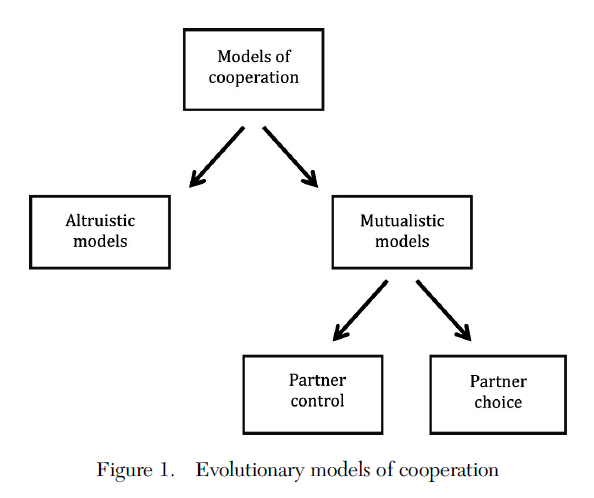
Cooperation comes in two forms: altruism and mutualism, depending on who benefits:
“you”, or “us”. Altruism is defined as one-
Michael Tomasello (2016) identifies two kinds of mutualistic cooperation: joint,
and collective; between individuals, or large-
The idea that we are responsible to collaborative partners implies that we are not responsible in the same way to people outside the group, team, or partnership. We may feel empathic concern for outsiders.
Dual-
“Bird's eye view” and self-
Self-
In the minds of its partners, mutualistic cooperation has a dual-
Self-
What is more, you and I are equally bound by the instrumental demands, to perform ideally the duties of our roles, and this has the effect of constraining our egos impartially, levelling our status.
You and I are equally causative agents in the collaboration, and therefore equally necessary.
If I recognise that you are equivalent to me in all important ways, with respect
to the collaboration, then this leads me to respect you because you are “just like
me”. Whereas the universe of the great ape individual is relatively self-
Fairness, as distributive justice, is simply the responsibility to share the rewards
of collaboration with one’s partners on the basis of self-
Mutual risk and strategic trust
For me to collaborate with another person is an inherently risky way to achieve my
goals, since people are fallible and may let me down, as I may do them. However,
I have no choice but to trust them, at least for as long as it makes rational sense,
i.e., that it is in my own interests to continue to trust them. If they show themselves
to be unworthy of trust, it is no longer self-
Mutual risk implies the need for me to mitigate my risk through partner control, trying to make my partner behave as ideally as possible. Strategic trust implies the possibility of partner choice, as I might decide to ship out and find another partner if this one lets me down.
Partner choice
When initially looking for a partner to collaborate with, all I have to go on is their track record: their publicly known reputation, or my personal experience of them, as a skilled or poor collaborator and worker.
If my partner lets me down, I may be forced to exercise partner choice and find a new partner. The threat of partner choice is thereby an enforcer of good behaviour in partners.
Partner control
Partner control is where I attempt to turn a failing or disrespectful partner into
a good one, through such means as respectful protest, punishment, or the threat of
exercising partner choice and finding a new partner. If I have cause, then while
assuming an attitude of respect because you are ostensibly a good-
The claim is that the individual partners internalise this process of universal partner
control, through self-
Partner control is thereby a fundamental part of the architecture of mutualistic cooperation, that shapes the personal and interpersonal psychology of the individual partners. It is the basis of moral regulation itself: as partners regulate each other and themselves on behalf of their joint agent “we”, in the direction of collaborating ideally to fulfil instrumental duties and moral norms.
Legitimacy of partner control
Partner control is seen as legitimate by partners, as they voluntarily entered into an agreement to collaborate. This legitimacy makes it permissible for “us” to use partner control on the self and other partners.
Moral identity
… an obligation always takes the form of a reaction against the threat of a loss of identity.
Christine Korsgaard (1996:102) – “The sources of normativity”
My personal moral identity is my opinion of my own moral state – my own judgement of myself as a moral person. We say things like, “I don't want to be the kind of person who [e.g.] breaks promises, that's not me.”
My public moral identity is my reputation: the judgement of others of me as a moral person.
Mutual respect and deservingness
Mutual respect and deservingness are at the heart of mutual responsibility and obligation.
They are based in turn on mutual value and self-
Partners are valuable to each other as partners, which breeds mutual respect. Partners are equivalent to each other in important ways. If someone is equivalent to me, and a valuable partner, then they must (I feel) be equally as deserving of respect as myself, with regards to the collaboration.
Bipolar claims and responsibilities
Between partners there is a “bipolar” arrangement of rights and responsibilities, where each defines the other. I have:
- the right to exercise partner control; I can make claims on you;
- the responsibility to be a good partner, to collaborate ideally, and to uphold moral norms; I allow you to make claims on me.
As partners, all regulation between you and me is seen as legitimate by “us”, because we willingly agreed to collaborate.
Tomasello (2020) proposes that mutual partner control shapes the interactions between
partners, in that while I am legitimately partner-
In a legitimate act of partner control, therefore, I need to be able to make claims on you, to be able to press your accountability. For different reasons, you feel a sense of responsibility towards me, with exactly the same end: for you to be an ideal collaborative partner (Darwall, 2006 > Tomasello, 2020). These claims and responsibilities thereby define each other: I want you to do the same behaviour that you feel you should do.
Reciprocity of deserving and owing
If I am deserving, that implies I am deserving of something, that I should be given something, that I am owed something. But why?
Reciprocity, as a norm, may be a feature of primates in general and many other kinds of animals as well. When someone gives us something, the urge to give them something in return is treated as an obligation. The binding strength of this norm suggests a strong selection pressure for its evolution.
For me to reciprocate with someone else, is because they have done something for
me, and because they have done something for me, I feel they are deserving. Evolutionary
ethics assumes that a psychological orientation must have evolved because generally
in the past it supported adaptive behaviour. Is there a plausible self-
Reciprocity in primate social life takes the form of trading grooming and other favours (e.g., a mother letting another female hold her baby for a while) for valuable social resources such as more grooming, reproductive privileges, and/or allyship and support in fights and coalitional disputes (Schino and Aureli, 2007; Testard et al., 2024).
Non-
Hence, as a primate, it is adaptive, psychologically and behaviourally, for me to
see as deserving and want to pay back those group-
External sources of obligation
Obligation is a binding force to do something. We may note several kinds of obligation, such as moral obligation, legal obligation, and instrumental obligation. Of these, only instrumental obligation (ultimately grounded in bodily welfare) is forceful enough to bind itself. Moral and legal obligations are formed, at least sometimes, out of respect for morality and the legal system, which is optional. They too may be subject ultimately to instrumental obligation, for example the threat of being sent to prison.
External sources of moral obligation are generally considerations of personal welfare, what will happen if I am not moral. Common sources include:
- my reputation;
- the goodwill of my fellows;
- the physical harm that may otherwise be caused;
- the failure of our mission.
Conscience and personal moral identity
The conscience is defined as the internal motive to follow moral norms (Dill and Darwall, 2014). The individual is motivated to see themselves in a good light (Kaufmann, 2018).
I am therefore motivated to maintain a good personal moral identity. This motivation may ultimately stem from my need to not get thrown out of my group; in which case, it would be adaptive.
In the case of collaborative responsibility, my sense of responsibility is deontological, in that it is voluntary – I strive to be an ideal partner for you for its own sake, and place myself under this obligation, as well as being obliged by instrumental reasons.
Group-
The claim is that within a large moral community, where most people are strangers to each other, individuals feel responsible to each other to be good citizens.
Moral responsibility within a large collaborative moral community is based on a universalised
and scaled-
Partner control in the direction of upholding moral norms, face-
Where face-
Self-
Therefore, when one stranger encounters another from the same moral community, e.g., in the neighbourhood where they live, there is a sense of responsibility to treat one another with the respect and deservingness due to a valued and respected collaborative partner.
Deontological responsibility
The idea is that when I voluntarily do the right thing, i.e., voluntarily uphold a moral principle P, it is because I endorse P as a course of action; I think that P is a permissible way of doing good.
In evolutionary ethics, a moral principle is an ideal method of cooperation towards mutualistic or altruistic benefit (Tomasello, 2016). Alternatively, it is a solution to recurring problems in cooperation (Curry, 2016). As such, it is an abstract behavioural formula or schema aimed at doing good in the world.
The claim is that human beings value and respect particular moral principles in the abstract, for the good they are capable of doing, and this value and respect leads people to uphold moral principles for their own sakes.
We will take promise-
Example: promise-
Promise-
We may ask, what are these reasons, and why are they generated?
Kiesewetter claims that normativity is generated by reasons: that only reasons are always sufficient to provide shouldness or normative pressure. Perry (2026) claims that reasons are generated by value: that having a goal generates reasons to act.
Accordingly, in the present account, it is the value and respect placed in moral
principles as abstract entities that generates reasons to, say, keep a promise. I
keep my useless promise because I value and respect promise-
In keeping with the collaborative context of moral principles, a promise is an arrangement between people for the purpose of achieving some good. Hence, I fail to keep a promise, I am letting my partners down, who don't deserve it, and it is disrespectful. It would be irresponsible. This model applies to any moral principles squarely aimed at mutualistic and altruistic benefit: for example, fairness and reciprocity.
Deontological obligation
I may endorse a moral principle so much that it becomes a self-
References
Bar-
Curry, Oliver Scott (2016) – “Morality as Cooperation: A Problem-
Darwall, S (2006) – “The second-
Dill, Brendan; and Stephen Darwall (2014) – “Moral Psychology as Accountability”;
in Justin D’Arms & Daniel Jacobson (eds.), “Moral Psychology and Human Agency: Philosophical
Essays on the Science of Ethics” (pp. 40-
Kaufman, Scott Barry (2018) – “The Pressing Need for Everyone to Quiet Their Egos
– Why quieting the ego strengthens your best self”; Scientific American online, 21
May 2018, https://blogs.scientificamerican.com/beautiful-
Kiesewetter, Benjamin (2022) – “Are All Practical Reasons Based on Value?”; Oxford
Studies in Metaethics, Volume 17; Russ Shafer-
Perry, Simon (2026) – “Understanding morality and ethics”; https://orangebud.co.uk/web_book_2.html
Scanlon, T M (1998) – “What We Owe to Each Other”; Harvard University Press
Schino, Gabriele; and Filippo Aureli (2007) – “Grooming reciprocation among female
primates: a meta-
Testard, Camille; Sébastien Tremblay; Felipe Parodi; Ron W DiTullio; Arianna Acevedo-
Tomasello, Michael (2016) – “A Natural History of Human Morality”; Harvard University Press, Cambridge MA
Tomasello, Michael (2020) – “The moral psychology of obligation”; Behavioral and
Brain Sciences 43, e56: 1-
Tomasello, Michael; Alicia P Melis; Claudio Tennie; Emily Wyman; Esther Herrmann (2012) – “Two Key Steps in the Evolution of Human Cooperation – The Interdependence Hypothesis” – Current Anthropology, vol. 53, no. 6, Dec 2012